Welcome to our company !


Call Us08045477197

 Send Inquiry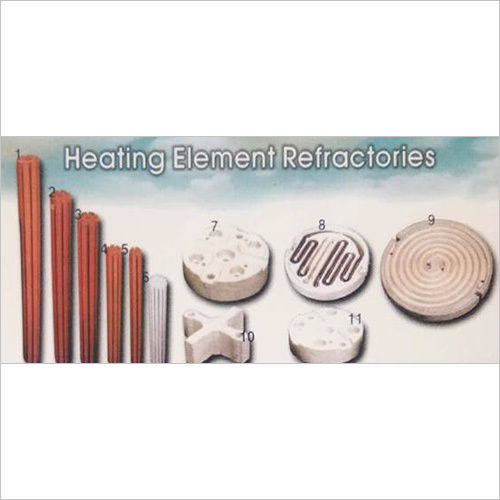
Heating Element Refractories
Product Details:
- Mounting Type Horizontal / Vertical / Flange Mounted
- Diameter Customized as required
- Usage Heating and Insulation in High-Temperature Applications
- Terminal Type Ceramic Insulated Terminal Blocks
- Heating Element Kanthal / Nichrome Wire Embedded
- Features High Temperature Resistance, Electrical Insulation, Durable, Energy Efficient
- Voltage 220V / 380V / 415V
- Click to view more
X
Heating Element Refractories Product Specifications
- Customized as required
- Horizontal / Vertical / Flange Mounted
- Customizable as per requirement
- Ceramic Fiber
- Heating and Insulation in High-Temperature Applications
- Ceramic Insulated Terminal Blocks
- High Alumina Refractory
- Kanthal / Nichrome Wire Embedded
- 220V / 380V / 415V
- High Temperature Resistance, Electrical Insulation, Durable, Energy Efficient
- Industrial Furnaces, Kilns, Ovens, Laboratory Heating
- Single / Three Phase
- Up to 1600C
- 50/60 Hz
- Tube / Rod / Plate
- 60 - 80 MPa
- 2.7 - 3.0 g/cm3
- Smooth / Glazed
- 0.18 - 0.35 W/mK
- Excellent
- White / Off White
- Available as per design and requirement
- 18% - 22%
Product Description
We are dealing in manufacturing and supplying of industrial grade Heating Element Refractories that can be used in industrial heaters to keep heat flow in one direction only. It is made up by using top-quality ceramic that are added with various thermally resistant elements which lead to high robustness and capability to resist extreme temperature. It is available in various shapes and sizes as per the areas where it is going to be installed. Heating Element Refractories can be easily installed with the help of mechanical fasteners. Buyers can get top-grade heating element with an assurance of fast and safe delivery.
Engineered for High-Temperature Performance
Our high-alumina heating element refractories are developed to handle challenging thermal conditions in industrial heating applications. Withstanding temperatures up to 1600C, they deliver both superior mechanical integrity and impressive resistance to thermal shock, allowing for safer and longer operational life. Their porous yet robust structure aids in efficient insulation, reducing energy consumption and running costs over time.
Customizable Solutions for Every Requirement
Whether you require a specific shape, power rating, or mounting configuration, we tailor our refractory heating elements for your needs. Our offerings include tubes, rods, plates, various size options, and multiple mounting and terminal types. Both single-phase and three-phase units are available, ensuring compatibility with diverse electrical setups in industrial and laboratory environments.
FAQ's of Heating Element Refractories:
Q: How are the heating element refractories customized to meet specific application needs?
A: We offer customization for shape (tube, rod, plate), size, diameter, power output, voltage (220V/380V/415V), mounting type (horizontal, vertical, flange), and terminal blocks. This allows us to closely match your design and performance requirements for any industrial application.Q: What is the process for installing these refractory heating elements in furnaces or kilns?
A: Installation involves mounting the refractory (via horizontal, vertical, or flange options), connecting the ceramic-insulated terminal blocks, and ensuring electrical and thermal integration as per equipment specifications. Our team can provide technical guidance or on-site assistance depending on your project needs.Q: When should I consider replacing the heating element refractories?
A: Replacement is recommended if you observe reduced heating efficiency, visible ceramic damage, electrical issues, or after prolonged operation near the material's upper temperature limit. Routine inspections help ensure optimal performance and safety.Q: Where can these refractory heating elements be used?
A: They are suitable for a variety of high-temperature applications, including industrial furnaces, kilns, ovens, and laboratory heating equipment. Their versatility and design flexibility support use in scientific, manufacturing, and thermal processing industries.Q: How do the physical properties benefit industrial heating processes?
A: High density (2.7-3.0 g/cm3), low thermal conductivity, and excellent compressive strength ensure effective heat containment, energy efficiency, and resilience to thermal shock, enhancing both safety and the longevity of the heating system.Q: What type of heating wires are embedded in these refractories?
A: We embed Kanthal or Nichrome wires within the refractory body for reliable, high-temperature heating performance. The choice of wire is based on your specific thermal and operational requirements.Tell us about your requirement

Price:
Quantity
Select Unit
- 50
- 100
- 200
- 250
- 500
- 1000+
Additional detail
Mobile number
Email

Other Products in 'Heating Components & Spares ' category

GST : 24BHBPS9354J1ZX

- S-69, Vivekanand Industrial Estate, Ahmedabad - 380021, Gujarat, India
- Phone :08045477197

- Mr. Pratik (Proprietor)
- Mobile :08045477197
- Send Inquiry

 Send Inquiry
 Send SMS
 Call Me Free
INDUSTRIAL CERAMICS
All Rights Reserved.(Terms of Use)
Developed and Managed by Infocom Network Private Limited.
Developed and Managed by Infocom Network Private Limited.

